Sports room ventilation: practical guide and checklists
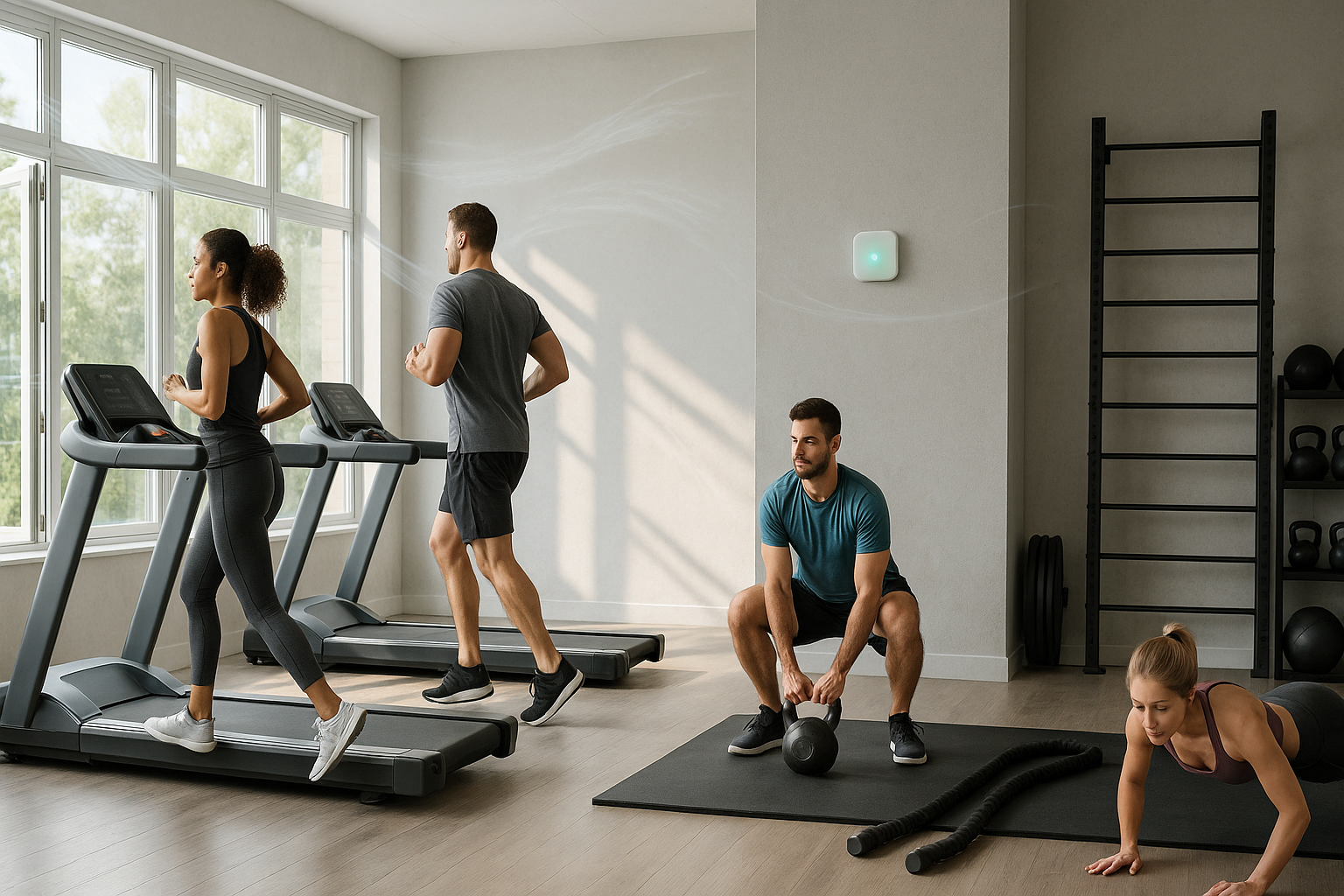

Air quality is not a detail: it is a lever for performance, comfort and loyalty. Well-designed gym ventilation lowers CO2, limits odors, reduces the risk of infection and improves the experience. This guide gives you a simple, costed and actionable plan.
Practical tip: associate your air strategy with your operational management. With EKKLO, you adjust slots, manage attendance levels and inform your members in real time. Discover the platform: EKKLO
Why ventilation can save you clients and sessions
Health, performance and perceived comfort
Air loaded with CO2 reduces oxygenation and concentration. At 1,000 ppm, fatigue increases, aches are more pronounced, sessions seem “harder”. Efficient gym ventilation maintains the air between 600 and 800 ppm during peaks.
Odors, humidity, noise: signals to watch for
- Odor persisting after 10 minutes of ventilation: insufficient flow.
- Mirrors that fog up: humidity poorly evacuated.
- Excessive blowing felt on the rower or treadmill: misdirected flows. These signals guide your “quick wins” before investing.
Business indicators to follow
- Cleanliness/odor rating in your Google reviews.
- Abandonment rate in group lessons after 20 minutes.
- Retention at 3 months of new members. Improving gym ventilation naturally increases these indicators.
To boost acquisition at the same time, take inspiration from this guide to attract your first clients: How to Get Your First 3 Clients When You Start as a Sports Coach
The simple technical basics to know
Air flow and renewal (ACH)
- Aim for 6-10 renewals/hour (ACH) during HIIT; 4-6 ACH on bodybuilding platform.
- Indicative flow rate: 20-30 m³/h/person on platform; 30-40 m³/h/person in intensive courses; 40-60 m³/h/person in changing rooms. Well-sized gym ventilation is based on actual occupancy.
CO2 sensors: your traffic lights
- Target: 600-800 ppm during exercise.
- Action threshold: 1,000 ppm (open, open, reduce the number of staff, or increase the flow rate).
- Alert threshold: 1,400 ppm (pause and air purge of 10 minutes).Choose sensors that can be calibrated, readable, positioned at breathing height, far from the insufflation vents.
Air flow: direct without “blowing on the faces”
- Air speed felt: 0.2-0.3 m/s max in static areas.
- Avoid direct jets facing rowers, bicycles and treadmills.
- Create a “clean to dirty” flow: air inlet in the exercise area, extraction on the exit/locker room side.
Filtration and purification
- MERV 13+ filters (or equivalent) on power plants; replace according to manufacturer.
- H13/H14 HEPA purifiers useful in closed studios: 5-8 volumes/hour, noise < 50 dB.
- Reminder: a purifier does not replace air renewal, it complements it.
Zone strategy: fine-tune where it counts
Reception and circulation
- Moderate but constant flow, automatic doors = short air inlets. Compensate with gentle extraction.
- Place a visible CO2 sensor: reassuring message of transparency.
Bodybuilding and cardio tray
- Distribute the machines so as not to create direct air “corridors”.
- Alternate the orientation of ceiling fans and continuous low speed.
- CO2 target: 700-900 ppm peak; add a HEPA purifier if partitioned space.
Studio group classes/HIIT
- Allow 5-10 minutes of purging between two classes: doors/windows open + full extraction.
- Limit the number of people if the gym ventilation does not reach the CO2 target.
- Place the teacher on the extraction side to avoid flow towards the group.
Cloak rooms, showers and toilets
- Continuous dedicated extraction, increased speed on busy areas.
- Dry on the floor quickly: humidity = odors + mold.
- Record CO2 and humidity twice per day the first week of development.
Install, measure, adjust: 30-day plan
Week 1: express audit and measurements
- Flow map: note where the air enters/exits and where it “stagnates”.
- Place 2-3 mobile CO2 sensors and turn them during the day.
- Measure 3 full slots and 1 hollow; record peaks and durations.
Week 2: quick wins without budget
- Synchronize opening of windows/doors: 3-5 minutes every 60-90 minutes.
- Stagger classes to avoid overlapping peaks.
- Reposition 2 machines blowing facing each other. face; lower the fan speed.
Week 3: Useful and targeted purchases
- 1-2 HEPA purifiers for closed studios (5-8 volumes/hour).
- MERV 13+ filters for HVAC; store 1 set in advance.
- CO2 sensors connected to log data and drive your decisions.
Week 4: protocols, display, team
- “Semafor” CO2: green < 800, orange 800-1200, red > 1200 ppm.
- Opening/between-classes/closing checklists (below).
- Automatic messages to members in the event of high heat/pollution: offer cooler slots.
To simply implement these routines, see how to use technology to optimize your sessions: How to Use Technology to Optimize Your Sports Coaching Sessions
On the organizational side, EKKLO helps you adjust planning, notify members and monitor satisfaction, in one place: EKKLO
Budget and ROI: invest in the right place
0-200 €: rapid impact
- Reliable CO2 sensor (70-150 €).
- Door/window seals to limit unwanted leaks.
- Floor marking to reposition machines and improve flow.
200-1,000 €: sensitive comfort
- HEPA H13 purifier for studio (300-600 €).
- Quiet variable speed ceiling fans.
- Silent blocks to reduce system vibration/noise.
€1,000-5,000: decisive upgrade
- Addition of localized extraction for changing rooms.
- Automation basic: triggering on CO2 threshold.
- Upgrade filters and network balancing.
Prove the ROI, concretely
- -0.2 to -0.5 average odor point in reviews in 6 weeks.
- +10-20% fill on “late” slots after improvement of the comfort.
- -15% of coach absences linked to headaches/fatigue over 3 months. Well-calibrated gym ventilation can be seen in your metrics.
Daily operations: ready-to-use checklists
Before opening (5 minutes)
- Air purge 5 minutes (doors/windows + strong extraction if possible).
- Check sensors (battery/connection) and display the CO2 color code.
- Start ceiling fans at low speed.
Between two slots (2 minutes)
- Open 2 opposite exits for 2-3 minutes.
- Activate the extraction “boost” mode.
- Quickly wipe damp areas to limit odors.
Closing (7 minutes)
- Final purge: 7 minutes of cross aeration.
- Note the CO2 peaks of the day; identify the slots to adjust.
- Plan replacement of filters if threshold reached.
Weekly/Monthly
- Vacuum grilles and vents; change filters according to meter.
- Smoke test (optional) to visualize flows.
- Monthly review of CO2 data and decisions (staff, schedules, equipment).
To remember
- Effective gym ventilation maintains 600-800 ppm at peak times.
- CO2 sensors visible + simple protocols = member confidence.
- HEPA purifier helps, but never replaces air renewal.
- Short, repeated checklists are better than major poorly targeted work.
- Measure, adjust, communicate: it is also a marketing argument.
Conclusion and action plan
Immediate action (today)
- Install a CO2 sensor, map your flows, set up 3 planned purges per day.
- Adjust class occupancy to meet the target < 900 ppm.
- Inform your members of the new rules: transparency = trust.
Go further with EKKLO
Plan your slots, alert in case of high traffic, send automatic messages and centralize your customer feedback on EKKLO: EKKLO
To save time on the operations side, find out how to automate your coaching business: How to Automate Your Business When You're a Sports Coach
Well-managed gym ventilation + fluid organization = more comfort, more loyalty, more results. Start your optimization today with EKKLO: EKKLO




The app for fitness coachespoweredbyClaude


Manage your clients, payments, and programs from one single platform. Spend less time managing and more time coaching.