Leg curl: professional coach's guide to strong and balanced hamstrings
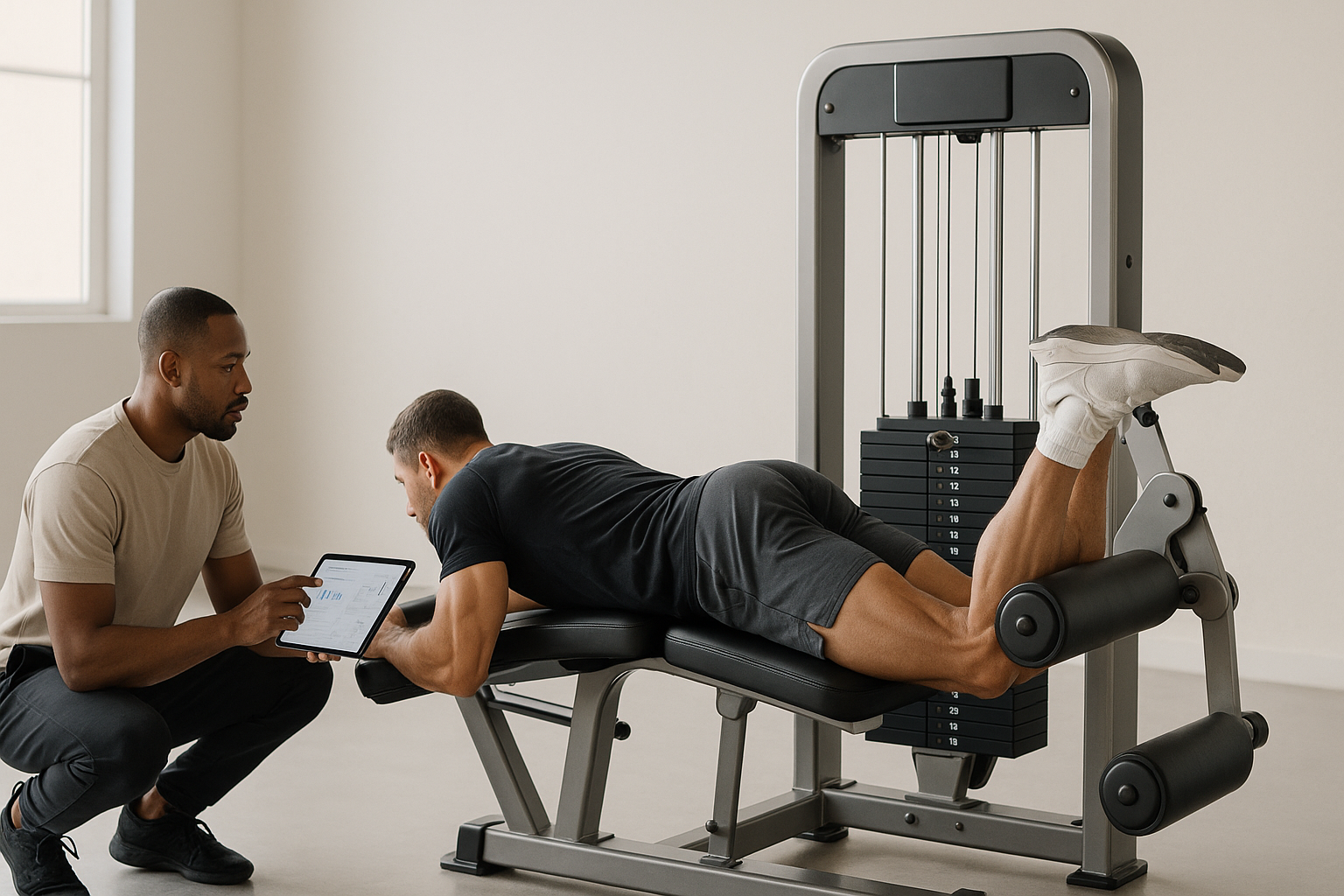

In this article, you'll find a clear method for teaching and programming the leg curl, with concrete benchmarks for improving hamstring strength, reducing injuries, and tracking your clients' progress. You can centralize your monitoring, payments and exchanges on the EKKLO platform to save time on a daily basis: EKKLO
Why this movement is strategic for a coach
The key role of the hamstrings
- Stabilize the knee and hip.
- Slow the extension of the knee when running/jumping.
- Contribute to accelerations, changes of support and landings.
Targeted strengthening reduces the risk of tightness and tears, common in field sports and sprinting.
Balance quadriceps and ischios
- Aim for a ischios/quadriceps strength ratio of at least 0.6 (ideal 0.7-0.8 for explosive sports).
- The leg curl provides useful isolation to compensate for a specific delay without tiring the entire system.
Prevention and performance
- More eccentric strength = better control at high speeds.
- Strong hamstrings improve hip posture and power transmission to the ground.
To structure your sessions without common mistakes, see this handy guide on programming mistakes to avoid: 5 Common Mistakes to Avoid When Designing a Coaching Program
Choose the best variant according to the objective
Seated: safety and stable amplitude
- Back supported, pelvis locked, cushion just above the malleoli.
- Interest: good insulation, comfortable for beginners and reathletics.
- Objectives: hypertrophy, technical learning, volumes moderate to high.
Lying: strong sensation and contraction
- Active abdominal sheathing to avoid hyperlordosis.
- Often “felt” more on the distal portion of the ischios.
- Goals: eccentric strength, tempo work, shorter and heavier sets.
Standing/unilateral: correct asymmetries
- Work leg by leg, focus on control and trajectory.
- Ideal for balancing right/left, limiting compensations.
Elastics/gliders at home
- Effective solution when the machine lack.
- Increasing tension useful for learning control and warming up.
Organization tip: create simple offers and schedules to sell and follow via EKKLO for your specific ischios sessions: EKKLO
Perfect technique: adjustments, execution, safety
Essential adjustments
- Knee axis aligned with that of the machine.
- Cushion on the lower calf (above the heels), not on the Achilles tendon.
- Amplitude: almost complete extension without locking the knee.
Execution step by step
- Basic tempo: 3‑1‑1 (3 s descent, 1 s pause in extension, 1 s rise).
- Rise while exhaling, contract hard for 1 s in flexion, come back down controlled.
- Shoulders and pelvis stable; no momentum or arch.
Breathing and bracing
- Inhale before the eccentric phase, brace, exhale while pulling.
- Maintaining a “neutral” rib cage limits the tilt of the pelvis.
Frequent errors (and quick corrections)
- Excessive arch: bring the navel closer to the bench and tighten the abs.
- Jerky movements: reduce the load, impose a tempo.
- Truncated amplitude: adjust the stops and the position of the cushion.
- Calf cramps: move the cushion slightly higher and think "heel to buttock » rather than “point towards shin”.
Progression and programming for lasting results
Benchmark volumes and intensities
- Beginners: 6-10 sets/week of hamstring isolation, RPE 6-7.
- Intermediates: 10-14 sets/week, RPE 7-8, 6-12 reps.
- Advanced: 12-18 sets/week depending on goal, heavy blocks 4-8 reps and quality eccentric blocks.
Intelligent overload
- 1 variable at a time: +1-2 reps, +2.5-5 kg, or +1 s eccentric.
- Micro-cycles of 3-4 weeks then week of discharge (‑30% volume).
Frequency and placement in the session
- 2-3 times/week depending on sport and tolerance.
- Rather after polyarticular movements (hinge/deadlift) to keep fresh nervous.
Sport-specific
- High-speed sports: eccentric emphasis (4-0-1 tempo, 2 s near extension isometry).
- Jumping sports: short series, controlled speed, focus on springback.
Mid-cycle? Automate reminders, session validation and feedback messages to save time: How to Automate Your Business When You're a Sports Coach
Effective alternatives when the machine is not available
Deadlift with straight legs (bar or dumbbells)
- Hip in priority, knee slightly bent.
- 3-5 sets of 6-10 reps, RPE 7-8, eccentric emphasis.
Hip hinge kettlebell and good mornings
- Excellent for the lumbo-pelvic hinge.
- 3-4 sets of 8-12 reps, tempo 3-0-1.
Nordic hamstring / GHR
- Very strong eccentric stimulus.
- Start with reduced amplitude, assistance bands if necessary.
- 2-3 sets of 3-6 quality reps, 2 times/week.
Slider/Swiss ball leg curl
- Ground variation: bilateral then unilateral curl.
- 3-4 sets of 10-15 reps, emphasis on hip extension.
Coach: evaluate, correct, follow without wasting time
Simple tests to guide the choice
- Single‑leg bridge hold: hold 20-30 s per leg without calf cramp.
- Hamstring length test (SLR active): compare right/left.
- Ratio of strength: if clear deficit, prioritize unilateral and eccentric.
Video cues to capture
- Tilt of the pelvis when climbing.
- Excessive ankle flexion (calf that “takes everything”).
- Speed difference R/L unilateral.
Walking cues
- “Heavy knee in the bench” to limit the arch.
- “Heel towards the buttock, neutral toe”.
- “Crush the pad, pull gently, hold hard at the bottom.”
Tracking data with EKKLO
- Create exercise templates with tempo and RPE cues.
- Record load, reps, RPE and feedback as perceived by the client.
- Simple graphics to visualize progress and adjust cycles.
Centralize your schedules, payments and messages on EKKLO to streamline the customer experience: EKKLO
Ready-to-use plans and practical cases
2 sessions/week (hypertrophy/balance)
- Session A: Seated leg curl 4×8-12 (RPE 7-8, 3-1-1), Hip hinge KB 3×10-12, Slider curl 3×12-15.
- Session B: Lying leg curl 5×6-10 (RPE 8, 3‑0‑2), Good morning 3×8-10, Seated calf raises 3×12-15.
- Progression: +1 rep/session or +2.5 kg when 12 reps mastered.
Recovery after hamstring discomfort (pain resolved, gently reconstructed)
- Week 1-2: Seated leg curl 3×12 (RPE 6, tempo 3‑2‑2), Bilateral slider 2×12, hip bridge isometry 2×30 s.
- Week 3-4: Light unilateral 3×10/leg (RPE 6-7), tempo 4‑1‑2.
- Progress criteria: no pain > 2/10 the next day, stable speed.
Sprint/jump athlete (eccentric accent)
- Lying down 5×6 (RPE 8, tempo 4‑0‑1), Nordic assisted 3×4, Med ball hip hinge 3×8.
- Heavy week then lighter week (‑30% volume) before competition.
Group lessons in studio (little equipment)
- Circuit: Slider curl 40 s, Hip hinge KB 40 s, Gluteal bridge 40 s, rest 20 s.
- 3-4 rounds, tempo and posture instructions, quick demos.
To remember
- Choose the variation that serves the objective: safety, isolation, asymmetries or eccentric.
- Technique before load: precise settings, controlled tempo, stable pelvis.
- Aim for 10-14 sets/week for the majority of practitioners, adjusted to tolerance.
- Regular eccentric protects the knee and improves speed.
- Follow load, reps and RPE for clear decisions and visible progress.
Conclusion: go from good to precise
The leg curl, properly programmed and executed, strengthens your hamstrings, balances the leg and reduces the risk of injury. Structure your blocks, measure your progress and offer your clients simple and motivating follow-up with EKKLO: EKKLO
To go further on the use of digital technology in your sessions, read this practical guide: How to Use Technology to Optimize Your Sports Coaching Sessions
And if you are starting or want to optimize your offer and your planning, discover how EKKLO can centralize your offers, reservations, payments and messages in just a few clicks: EKKLO



The app for fitness coachespoweredbyClaude


Manage your clients, payments, and programs from one single platform. Spend less time managing and more time coaching.