Initial Client Questionnaire for Sports Coaches: The Complete Assessment for Every New Client

Every new client who walks through your studio door or contacts you online arrives with a history, expectations, and constraints you do not yet know. The initial questionnaire is the tool that turns this unknown into actionable data. Without it, you are programming blind. With it, you lay the foundation for personalized coaching that is credible from the very first session. This guide covers the four building blocks of an effective initial questionnaire, the physical tests that complement it, and the method for converting this information into a tailored program.
Why the Initial Questionnaire Changes Everything
A coach who starts a session without an initial assessment takes a double risk: prescribing an exercise that is contraindicated by an undisclosed medical condition, or targeting a goal the client never actually stated. In both cases, trust erodes and the client drops out.
The initial questionnaire is not an administrative formality. It is the first professional act in your coach-client relationship. It serves three concrete functions.
- Securing the coaching process. Identifying pathologies, past injuries, and contraindications before touching a single exercise. A client with hypertension on medication will not do the same circuits as a healthy 25-year-old with no medical history.
- Aligning expectations. A client who says "I want to get back in shape" might want to lose 8 kg, run a 10K, or simply stop having back pain at the end of the day. The questionnaire forces precision.
- Structuring your client journey. The initial answers become the baseline reference for measuring progress at 4, 8, and 12 weeks. Without a quantified starting point, there is no way to prove the effectiveness of your coaching.
The American Council on Exercise classifies the initial assessment among professional practice standards: it reduces injury risk, increases program adherence, and gives the client a measurable reason to continue. In practice, a client who sees their starting measurements in black and white commits more easily to a 3- to 6-month program than a client who starts without a reference point.
The 4 Building Blocks of an Effective Initial Questionnaire
A questionnaire that is too short misses critical information. A questionnaire that is too long discourages the client before the first session even begins. Aim for 15 to 25 questions spread across four blocks, completable in 10 minutes.
Block 1: Health and Medical History
This is the priority block, the one you cannot skip. In France, the Code du Sport (article L231-2-1) requires a health certificate for supervised sports practice. Your questionnaire complements this legal obligation by collecting the operational details. Wherever you coach, verifying your client's health status before programming any exercise is a professional and legal baseline.
- Chronic conditions: diabetes, hypertension, asthma, epilepsy, cardiac disorders
- Past and current injuries: tendinitis, fractures, herniated discs, recurring sprains
- Recent surgical procedures (within the last 12 months)
- Current medications (certain beta-blockers limit maximum heart rate, which changes your training zones)
- Current joint or muscle pain, even mild
- Current pregnancy or recent postpartum
Add an open-ended question: "Is there anything else I should know about your health?". Clients sometimes omit information they consider unrelated to exercise (sleep disorders, chronic anxiety), even though these factors directly affect recovery and progression.
Block 2: Athletic Background and Current Fitness Level
This block places the client on the beginner, intermediate, or advanced scale and identifies their current habits.
- Sports practiced in the past, at what level, and for how long
- Current physical activity: type, weekly frequency, session duration
- Experience with a coach or a structured program
- Familiarity with foundational movements (squat, push-up, plank, deadlift)
- Available equipment (if coaching at home or online)
A former rugby player who has not exercised in 5 years is not a beginner in motor terms, but their cardiovascular system has lost capacity. Conversely, a person who walks 10 km a day has a solid aerobic base without knowing a single resistance training movement. The athletic background prevents you from putting everyone in the same box.
Block 3: Goals and Motivations
This is where you move from the medical to the personal.
- Primary goal, stated by the client in their own words
- Secondary goals
- Desired timeline (realistic or not, it is your role to recalibrate)
- Deeper motivation: why now? A triggering event (wedding, birth of a child, health scare) anchors motivation far better than a vague "I want to feel better"
- Past experiences of failure or quitting: understanding what went wrong before prevents repeating the same pattern
Block 4: Lifestyle and Practical Constraints
This block is often overlooked, yet it determines whether the program is actually feasible.
- Work schedule and availability for sessions
- Professional and personal stress level (self-assessed on a scale of 1 to 10)
- Sleep quality: average duration, difficulty falling asleep, nighttime awakenings
- Eating habits: number of meals per day, dietary restrictions (vegetarian, allergies, intolerances), alcohol consumption
- Logistical constraints: commute time, childcare responsibilities, frequent travel
A program that looks perfect on paper but requires 4 sessions per week from a client who travels 3 days out of 5 is a program destined to fail. Two realistic sessions that are actually completed beat four theoretical sessions abandoned after 3 weeks.
Physical Tests That Complement the Questionnaire
The questionnaire collects self-reported data. Physical tests measure concrete results. The two work together to form a complete initial assessment.
Cardiovascular Tests
The Ruffier-Dickson test is the simplest to administer in a studio: 30 squats in 45 seconds, three heart rate measurements (resting, effort, recovery). The resulting index classifies the client's cardiac capacity. For a more thorough endurance evaluation, the Cooper test remains the gold-standard field assessment: 12 minutes of running, distance measured, VO2max estimation.
Strength and Muscular Endurance Tests
- Push-ups: maximum number in a single set (knees on the floor if necessary)
- Front plank: hold time in correct position
- Bodyweight squat: range of motion, stability, symmetry
- Estimated one-rep max on a foundational lift (bench press, barbell squat) for intermediate and advanced clients
Flexibility and Mobility Tests
- Sit-and-reach test for the posterior chain
- Shoulder rotation with a stick
- Thomas test for hip flexor flexibility
- Overhead deep squat with arms extended: this single movement reveals mobility restrictions at the ankles, hips, thoracic spine, and shoulders
Body Composition Measurements
- Weight and height (BMI calculation as a reference point, not a verdict)
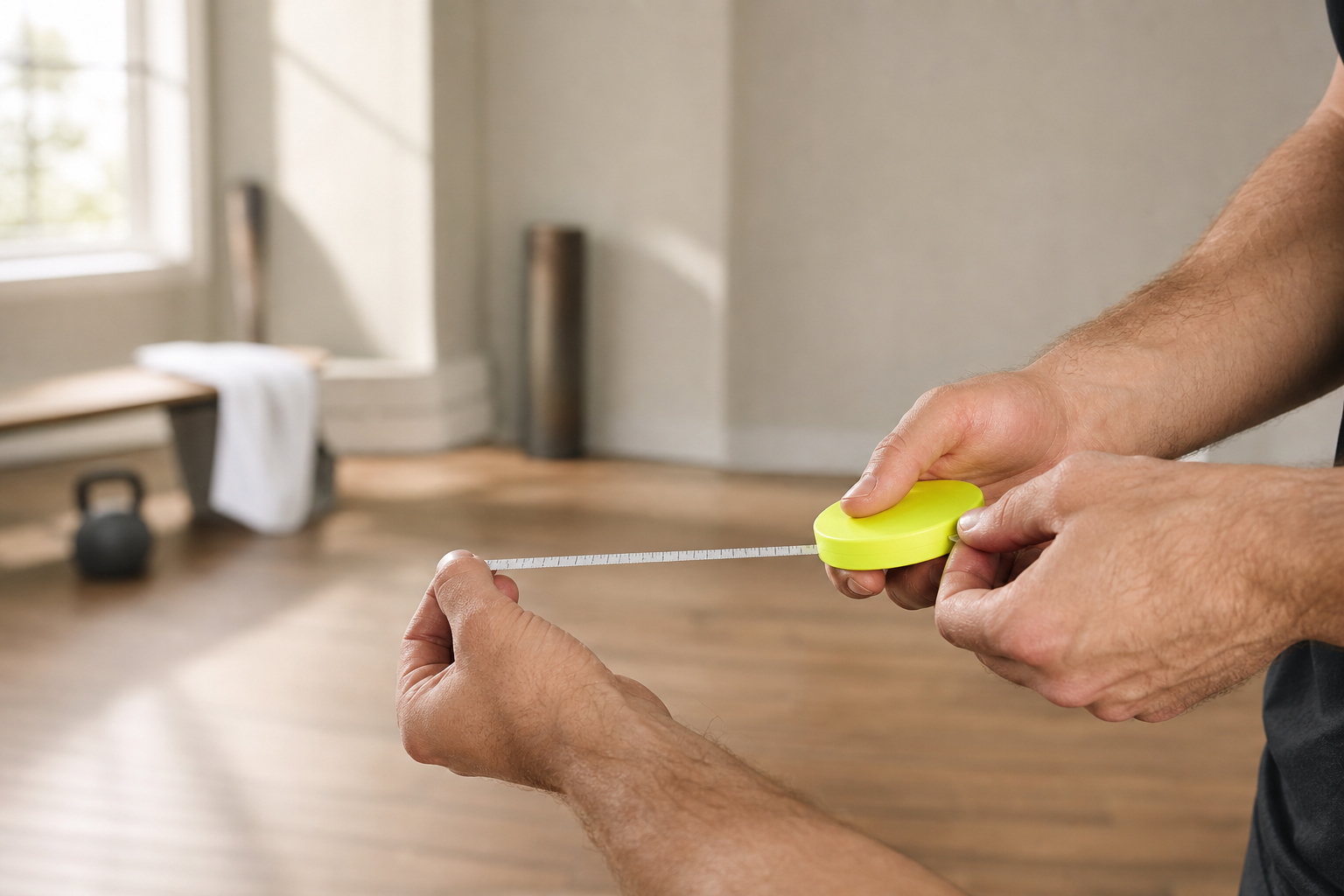
- Waist circumference, hip circumference, arm circumference, thigh circumference
- Bioelectrical impedance analysis if you have the right scale (body fat percentage, muscle mass, hydration)
- Standardized photos (front, side, back) with the client's explicit consent
Record all results in a document that you share with the client. Transparency strengthens trust and engagement.
How to Use the Answers to Build the Program
A well-completed questionnaire is useless if it stays in a drawer. Every answer must translate into a programming decision.
From Health Data to Adaptations
Identify contraindicated exercises and their substitutions. A client with an L5-S1 herniated disc will not perform a conventional deadlift, but can work the hip hinge with a kettlebell sumo deadlift. A client with exercise-induced asthma will progress better with short intervals and longer recovery periods.
From Current Level to Starting Load
Physical test results set the starting intensity. A client who holds a plank for 20 seconds will not start with 60-second planks. Begin from the measured result, then add 10 to 15% as the first progression target at 4 weeks.
From Goals to Planning
Weight loss: prioritize metabolic circuits combined with a guided caloric deficit. Strength gain: linear periodization programming, heavy loads, long rest periods. General well-being: variety of stimuli, enhanced mobility component, enjoyment before performance.
From Lifestyle to Scheduling
Two coached sessions per week are enough if you add a light autonomous program for the days in between. Adapt training days to peaks in professional stress: a client coming off a 12-hour workday will get nothing out of an intense session at 8 PM. To set up structured tracking that retains this information week after week, see the complete client tracking method for sports coaches.
Follow-Up Assessments: When and How to Re-Evaluate Your Clients
The initial questionnaire sets the starting point. The follow-up assessment measures the distance covered. Plan a re-evaluation every 6 to 8 weeks.
What You Re-Measure
Repeat the same physical tests, the same body composition measurements, and the same subjective questions (energy level, sleep quality, pain). The comparison is only valid if the measurement conditions are identical: same time of day, same protocol, same test order.
What You Adjust
Increase loads and volumes if progression is on track. Change your approach if a goal has stagnated for two consecutive assessments. Re-evaluate the goals themselves: a client who wanted to lose weight in January may want to prepare for a trail race in September.
How to Present the Results
Show the client their progression curve, not just the latest number. A simple chart (weight, waist circumference, plank time over 3 months) is worth more than a speech. The 5,500 coaches who use Ekklo find that this visual feedback reduces mid-program dropouts.
How Ekklo Centralizes Your Client Assessments
Ekklo integrates assessment creation directly into each client's profile. You define your tests, record the results, and the platform automatically generates comparisons between successive assessments. No more scattered spreadsheets or paper forms lost between sessions. Explore the integrated assessment feature to see how to structure your assessments in just a few clicks.
Create your Ekklo account and start structuring your client assessments.
Key Takeaways
- The initial questionnaire is the first professional act in the coach-client relationship: it secures the coaching process, aligns expectations, and establishes a measurable starting point.
- Structure it in 4 blocks (health, athletic background, goals, lifestyle) to cover every angle without discouraging the client.
- Complement self-reported data with physical tests: cardiovascular, strength, flexibility, and body composition measurements.
- Every answer must translate into a programming decision, otherwise the assessment remains a useless document.
- Re-evaluate every 6 to 8 weeks to adjust the program and prove progression to the client.
Frequently Asked Questions




The app for fitness coachespoweredbyClaude


Manage your clients, payments, and programs from one single platform. Spend less time managing and more time coaching.