Home personal training: how to start and grow your business

Home personal training is a real opportunity for independent coaches: minimal fixed costs, clients willing to pay a premium for convenience, and (in many countries) tax incentives that make your rates highly competitive. In France, for example, the 50% tax credit tied to the Service à la Personne (SAP) scheme turns a 60 € session into just 30 € net for the client. Yet many coaches hesitate to take the leap because they lack a clear method. This guide covers the entire chain: from legal requirements to landing your first clients, including equipment and daily scheduling.
Why home coaching is a growth lever
Demand for home personal training keeps rising. Household spending on personal services has been growing steadily since 2020, driven by an aging population and the remote-work boom. For an independent coach looking to structure a business, the home-based model offers three clear advantages.
The first: near-zero fixed costs. No gym rent, no facility charges, no heavy equipment to depreciate. Your investment comes down to a bag of portable gear and your vehicle.
The second: a competitive edge through tax incentives. In France, the SAP tax credit cuts the real cost for the client in half. A session billed at 60 € only costs the client 30 €, a price no gym can match for one-on-one coaching. Many other countries offer similar mechanisms: the UK has tax-free benefits for employer-funded fitness programs, Australia allows certain health-related deductions, and several EU countries provide household-service tax credits. Check your local tax authority for equivalent schemes.
The third: a stronger client relationship. Training in your clients' homes builds a level of trust that a gym floor simply cannot replicate. Retention rates are often higher because the commitment happens in the client's own living environment.
Obtaining the Service à la Personne (SAP) approval (France-specific)
In France, the SAP approval is the cornerstone of the home coaching business model. Without it, your clients cannot claim the 50% tax credit, and your offer loses its main pricing advantage. If you operate outside France, look into your country's equivalent household-service or personal-service registration schemes, as many governments incentivize in-home wellness services.
Requirements
To be eligible in France, your activity must meet three criteria: sessions take place exclusively at the client's home, they are delivered to private individuals (not businesses), and you hold a recognized qualification (BPJEPS, CQP, STAPS or equivalent).
Three paths to obtaining the SAP number
- Individual declaration: submit an application to your departmental DDETS office through the Nova portal. Processing takes 1 to 3 months. This option gives you full control but requires rigorous administrative management (annual tax certificates, quarterly declarations).
- Joining a SAP cooperative: organizations specializing in sports coaching lend you their approval number in exchange for a commission (5 to 10% of revenue). You keep your independence without the administrative burden.
- Working through a SAP umbrella company (portage salarial): you are employed by an approved umbrella firm. Less autonomy, but zero tax management and full social coverage.
Instant advance payment: a sales accelerator
Since 2022, the Avance immédiate system lets your clients pay only 50% of the amount at the time of the session, without waiting for the tax refund. Activate it through the URSSAF portal: it is free and removes the last barrier to purchase.
To choose the right legal framework alongside these steps, see the legal status guide for sports coaches.
Packing your mobile coaching bag
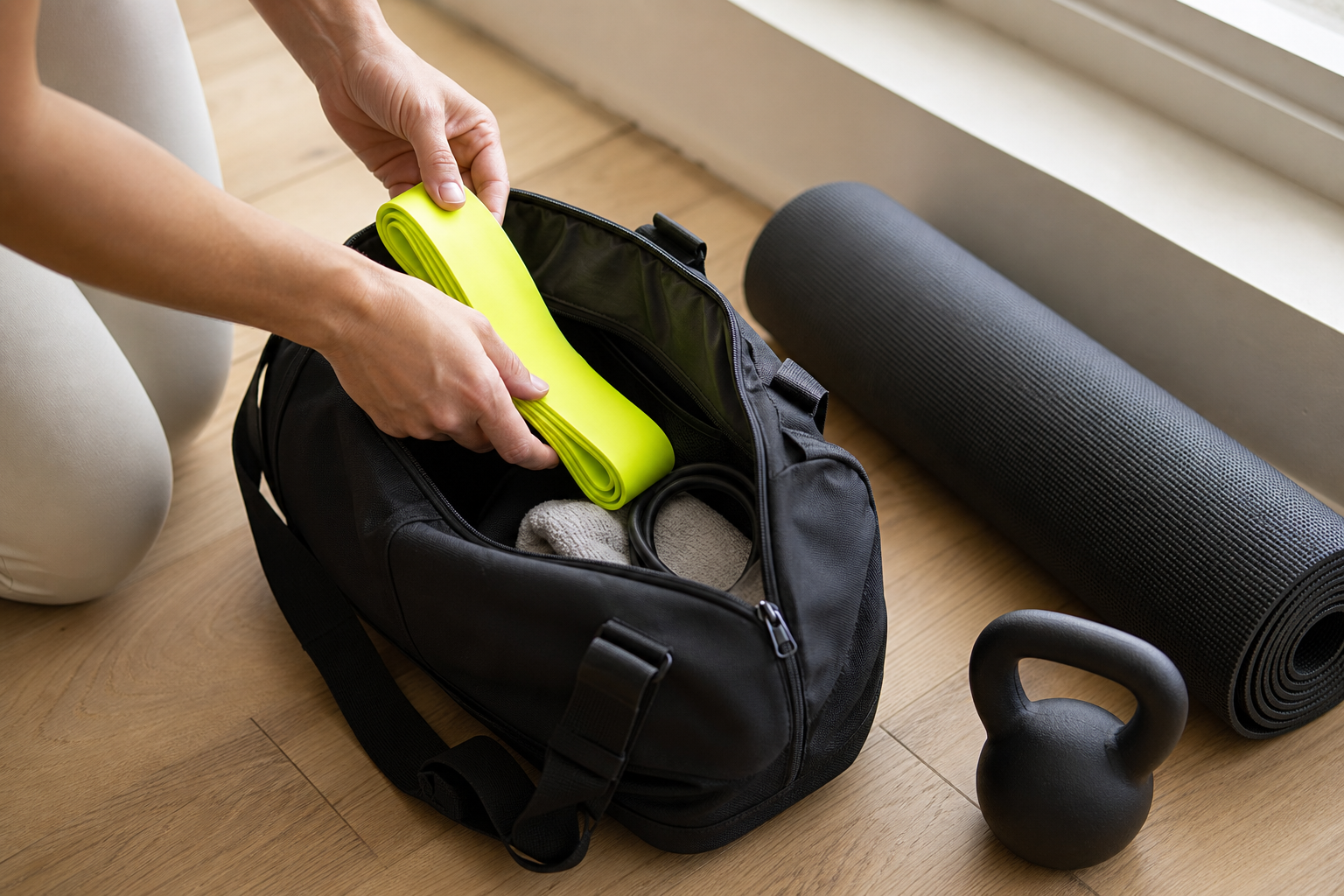
No need to overload your car. A well-thought-out kit fits in a single sports bag and covers 90% of your sessions.
Starter kit (under 300 €)
- Resistance bands (set of 5 levels): versatile, lightweight, suitable for all fitness levels
- Exercise mats: one for you, one for the client
- Suspension trainer (TRX-style): hooks onto a door and opens up dozens of exercises
- Foam roller: 5-minute post-session recovery
- Stopwatch and timer app: essential for HIIT and circuit training
Intermediate kit (300 to 800 €)
Add adjustable dumbbells (2 to 20 kg), a kettlebell (12 or 16 kg), a foldable step, and a set of mini bands for lower-body work.
Organizing your trunk
Store everything in a compartmentalized rolling bag. Keep a separate hygiene kit: hand sanitizer, disinfectant wipes, microfiber towels, and a first-aid kit (mandatory if you hold SAP approval in France, and good practice everywhere). Clean your equipment between every client.
Structuring your day and optimizing travel
Travel time is the hidden cost of home personal training. A coach who strings together clients 30 minutes apart loses 2 hours a day driving, or 10 unfilled hours per week. Here is how to cut that down.
Cluster clients by geographic zone
Divide your service area into 3 or 4 sectors. Dedicate each day or half-day to a single sector. Result: 10 to 15 minutes between sessions instead of 30.
Build buffers between sessions
Block 15 minutes between every slot for travel, equipment setup, and the unexpected (parking, a late client). A typical day for a home personal trainer looks like this:
- 8:00 to 9:00: client 1 (sector A)
- 9:15 to 10:15: client 2 (sector A)
- 10:30 to 11:30: client 3 (sector A)
- Lunch break
- 14:00 to 15:00: client 4 (sector B)
- 15:15 to 16:15: client 5 (sector B)
- 16:30 to 17:30: client 6 (sector B)
Six sessions a day, 30 to 35 hours a week, with travel time under control.
Adapt with the seasons
In summer, offer outdoor sessions (parks, gardens) to add variety and ease the indoor constraint. In winter, focus on indoor sessions and adjust your schedule to daylight hours.
Setting your home coaching rates
The price of a home personal training session must cover four items: session time, travel time, program preparation, and your overhead.
Calculating your real hourly rate
Take your target monthly net income, add your costs (social contributions, insurance, fuel, equipment), and divide by the number of actually billable hours. Here is an example for a coach operating as a micro-entrepreneur in France:
- Net income target: 3,000 €/month
- Social contributions (22%): 850 €
- Fuel + professional auto insurance: 300 €
- Professional liability insurance: 50 €
- Total to invoice: 4,200 €/month
- Sessions per month (5 days x 5 sessions x 4 weeks): 100
- Minimum rate per session: 42 €
With the SAP tax credit, the client only pays 21 €. That is below the market rate. You can therefore charge 60 to 75 € per session (30 to 37.50 € net for the client) and remain highly competitive. Even outside France, the principle holds: calculate your true cost per session including travel and prep time, then price accordingly.
Structuring packages to secure revenue
- Discovery pack (4 sessions + assessment): ideal for testing the relationship, at a slightly reduced rate
- Monthly subscription (8 to 12 sessions): the most profitable format, with automatic billing
- 12-week intensive pack: for transformation goals (weight loss, athletic preparation)
For a deeper dive into pricing logic, see the guide on how to set your prices when starting as a sports coach.
Finding and retaining home coaching clients
Client acquisition for home personal training is a local game. Your future clients live within a 15 to 20 km radius: that is where you need to be visible.
Local partnerships
Identify 5 healthcare professionals in your area (physiotherapists, osteopaths, sports physicians) and propose a referral exchange. A physiotherapist who refers a patient finishing rehabilitation to a home coach saves time for everyone involved.
Also consider pharmacies (window displays), real estate agencies (welcoming new residents), and local corporate wellness committees.
Local online visibility
Create and optimize your Google Business Profile: category "personal trainer", defined service area, photos of sessions (with client consent), and respond to every review. Searches like "personal trainer at home + city name" generate qualified local traffic at no cost.
Referral program
A satisfied client is your best salesperson. Offer one free session to the referrer and one to the new client for every recommendation that converts. With a referral rate of 20%, a portfolio of 15 clients brings you 3 new clients per quarter with zero advertising spend.
Insurance and peace of mind
Home coaching requires professional liability insurance with an "off-premises" extension. Make sure your policy covers damage to the client's property (a dumbbell dropped on a hardwood floor, for example). For a full overview, see the insurance guide for sports coaches.
How Ekklo supports home personal trainers
Managing a mobile schedule, tracking each client's progress, and sending invoices that comply with local regulations takes time. Ekklo centralizes everything in a single platform built for independent coaches.
Your clients book and pay online, you view your schedule by time slot, and progress tracking (measurements, performance, photos) happens directly from the mobile app. Automated reminders reduce last-minute cancellations, a frequent problem in home coaching.
Create your free account and see for yourself.
Key Takeaways
- The 50% SAP tax credit (in France) is your strongest sales argument: a 60 € session costs your client only 30 €. Check your own country for equivalent household-service tax incentives.
- Three options for SAP approval in France: individual declaration, SAP cooperative, or umbrella employment.
- A starter kit under 300 € is enough to cover 90% of home sessions.
- Cluster your clients by geographic zone to keep travel time under 15 minutes between sessions.
- Set your rates by factoring in travel and preparation, not just session time.
Frequently Asked Questions




The app for fitness coachespoweredbyClaude


Manage your clients, payments, and programs from one single platform. Spend less time managing and more time coaching.